


RAINFOREST LIFELINES - Amplifying Indigenous Voices

Updated: Jun 18, 2025
Filmed on location in London, RAINFOREST LIFELINES weaves together a ceremony of global solidarity, powerful testimony and insightful interviews, in the run up to COP30 in Brazil's Amazon.
WATCH our new, short film, then follow the links below to TAKE ACTION and Support Indigenous Land Defenders everywhere.
SARAWAK'S THREATENED FORESTS
Sarawak is Malaysia‘s largest state. Situated in Northern Borneo, it has suffered the
greatest primary forest loss of any tropical region since the late 1970s.

Fragile ecosystems and diverse Indigenous Peoples, along with their customary traditions and territories, remain under grave threat from logging, oil-palm plantations, hydropower projects and, increasingly, carbon trading schemes.
LIFELINES FOR ALL

CUT's grass-roots partners, SAVE Rivers Network and Keruan Organisation, work sensitively with local communities - empowering them to stand up to big business, encouraging sustainable development solutions and communicating the crucial wisdom held in the ancestral teachings of Indigenous Peoples. Ancestral teachings that put the well-being of land and community first. Teachings that have the potential to be LIFELINES for us all.
AN INTERNATIONAL COLLABORATION
Commissioned by Friends of the Earth (FOE), Rainforest Lifelines was devised and coordinated by UK artist and CUT co-founder, Gaby Solly, and SAVE Rivers’ Managing Director, Celine Lim, a Kayan leader from Long Pilah in Sarawak, who tirelessly advocates for the rights of Indigenous Peoples across the world.
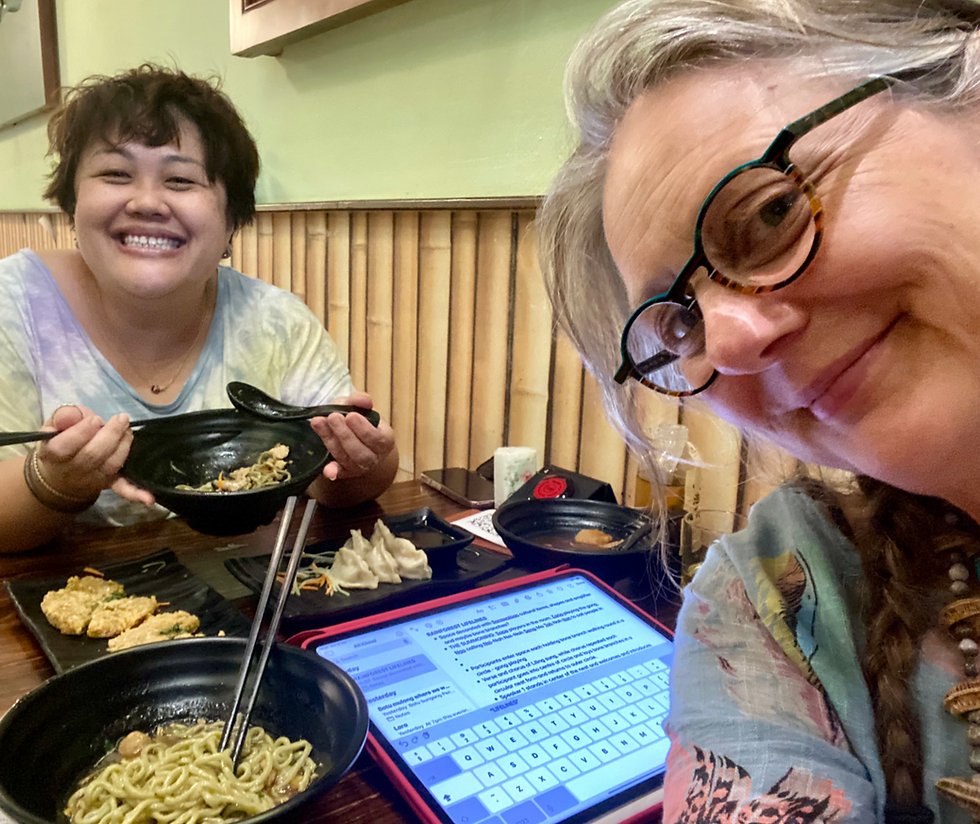
Close, international collaboration was key to ensuring that Sarawak’s Indigenous Peoples were authentically represented by Rainforest Lifelines, and that there was respectful, joyful engagement with the cultural traditions woven into the ceremony, by all those taking part in the UK.
Rainforest Lifelines was created to acknowledge, honour and amplify the ancestral wisdom of Indigenous Peoples, in Borneo and beyond, who have long safeguarded their forests, values, and ways of life, for the benefit of all beings.
It serves to remind us that solidarity is a lived experience - strengthened through collaborative action, mutual respect, and heartfelt connection.
SARAWAK IN THE UK
In April, a delegation of nine prominent Indigenous rainforest defenders from Sarawak journeyed to the UK to take part in a series of events - including the Rainforest Lifelines ceremonies held in London and Manchester. These were facilitated by CUT partners, FOE and Bruno Manser Fonds (BMF), and included visits to Kew Gardens, the Royal Geographical Society and Manchester Museum.
Kew Gardens Herbarium visit; Indigenous Solutions to Conservation - day of dialogue at the RGS; Rainforest Lifelines at Manchester Museum. (📷: Kate Moreton and Feng Ho)
CULTURAL REFORESTING
Allies from the UK, Europe and the Malaysian diaspora, joined with the Sarawakian delegation to perform Rainforest Lifelines in the woodlands of South West London.
We were hosted by Orleans House Gallery to complement its programme of Cultural Reforesting - a three year creative exploration which enquires - how can we renew our relationship with nature?

WHY A CEREMONY?
Rainforest Lifelines aims to connect people and purpose, through creativity and ceremony: for participants and audiences, in-person and online. We want to reach hearts and minds, in a way that campaigning alone cannot, in order to inspire action.
Poet, Eileen Pun, described taking part as “an opportunity to reflect, listen deeply, and participate in a way that decentralised the individual to instead focus in on - and respond to - the collective.”
The Rainforest Lifelines collective at Orleans House Gallery (📷: FOE)
PAST, PRESENT, FUTURE

The Rainforest Lifelines ceremony incorporated personal testimony to reflect the past, present and future aspirations of Indigenous Peoples in Sarawak.
Mutang Urud spoke in English, and Komeok Joe in Penan, explaining to the assembly that
"the custom of our ancestors reminds us that the land is to be protected and guarded for our children, and their children’s children. This is our duty. To protect what is here today for a future we will not live to see."
A SHARED RESPONSIBILITY

The exchange of Taba'eng Inu Buah Merah ceremonial necklaces, symbolically acknowledges the shared responsibility of Earth stewardship between generations within Borneo, and with their global allies,
Dayang Ukau, a young Penan activist proclaimed "a broken world is caused by broken people. And broken people are the result of the disconnection from one another, and the world around us. We now must share the same struggle to protect our world together. "
WE MOVE FORWARD TOGETHER
Representing a bold, new generation of youth activists in the UK, Moet Semakula-Buuza and Mya-Rose Craig, aka Birdgirl, pledged to Dayang and her fellow Indigenous land defenders "to protect our world together – to acknowledge the wrongs of the past, and present, to genuinely repair the disconnection between each other and our world today, moving forward together for our collective future."

CONNECTING THROUGH SONG
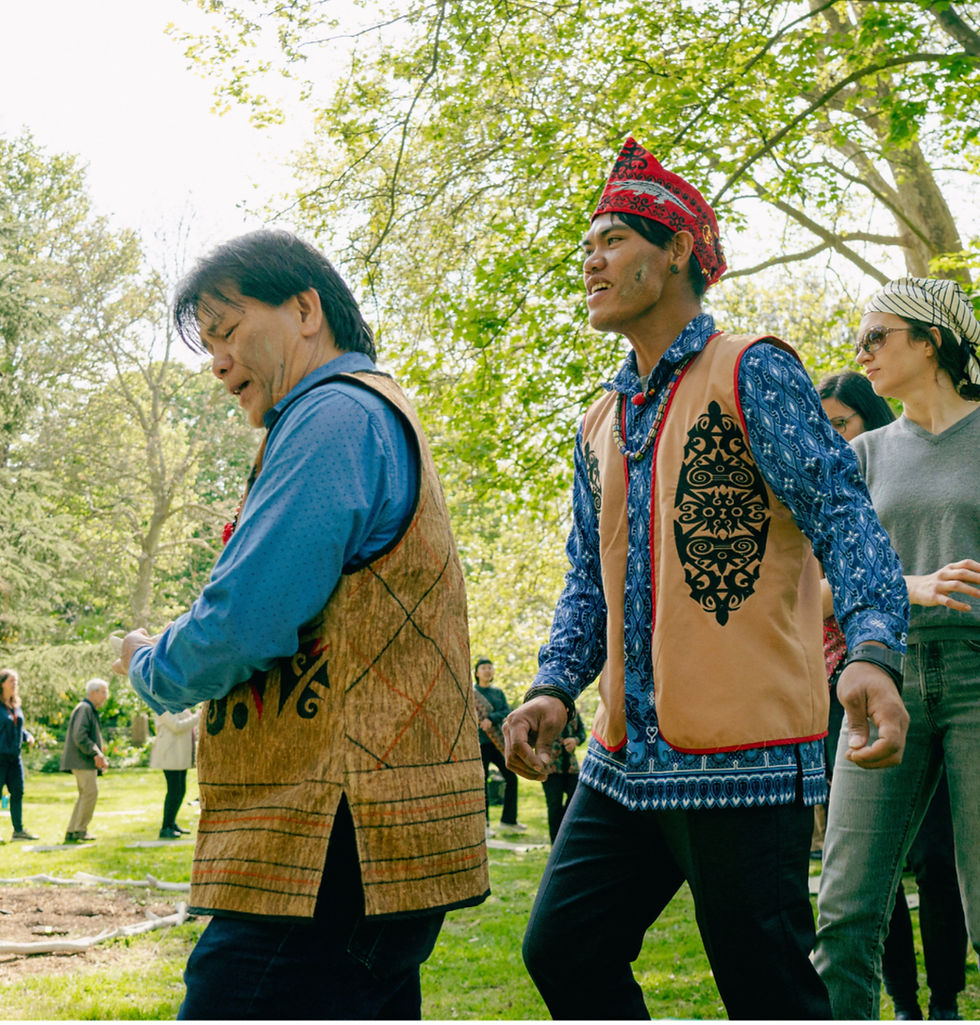
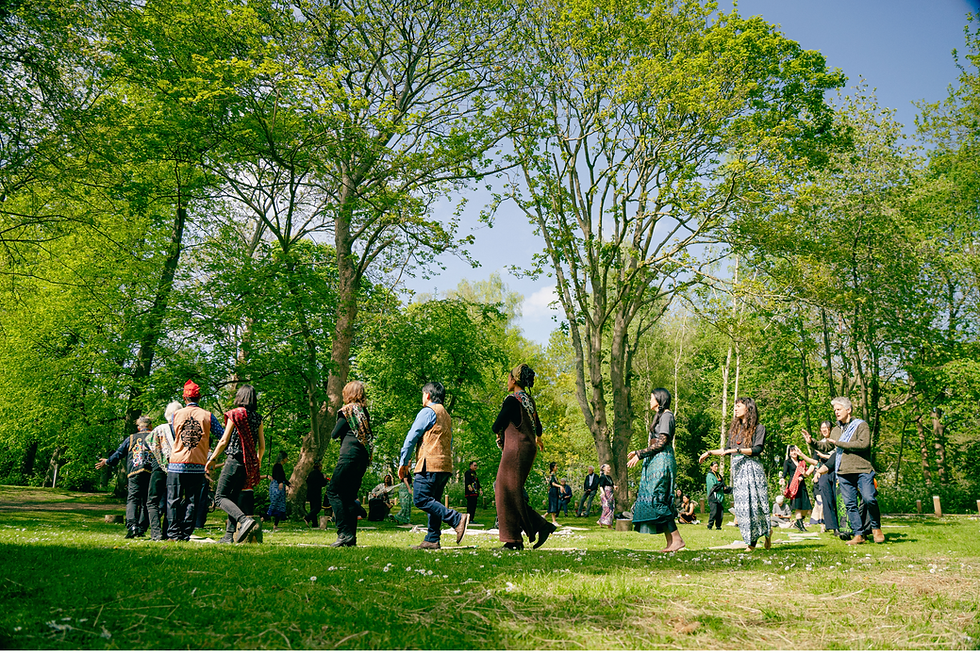
Rainforest Lifelines was devised around the Liling, a traditional song and circle dance of the Kayan and Kenyah tribes. The Liling has become an unofficial anthem of Sarawak, symbolising shared fellowship and unity amongst all its Peoples.
The Liling's chorus calls dancers to “go around together for real” - an invitation to be fully present with one another, circling in community.
BONDS OF FOREST AND BONE
CUT’s Poet in Residence, Eileen Pun, composed a new verse specially for our Liling, transporting it from the lush jungles of Borneo to England's Spring woodlands:
Circling, our shared moon makes us kin, Bonds of forest and of bone, returning, We are one!
Eileen worked in careful collaboration with Indigenous Sarawakian poets, taking her lead from Salomon Gau, and Adrian Jo Milang, who wrote a new Liling verse, in Kenyah, in response: Cha pu'un Lilu lini wai Ne sun wai ne sun ne saringan.
SOLIDARITY AS A LIVED EXPERIENCE
"Rights and justice are not separate from culture, memory, and celebration - you can disrupt systems in a joyful way.” (Rainforest Lifelines participant)
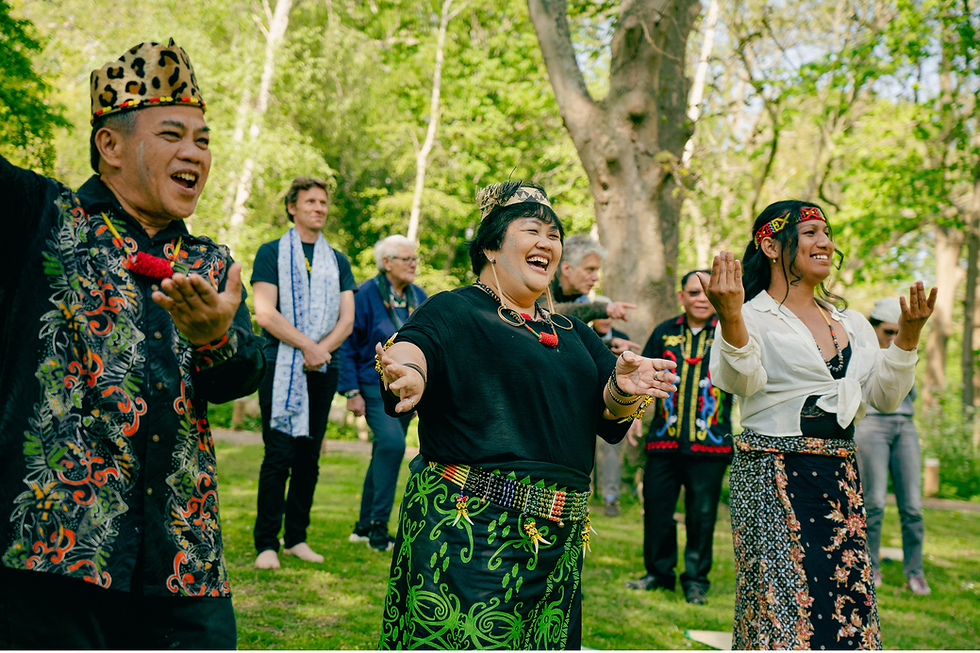
The ceremony concluded with an ash blessing conferred on all willing recipients. Traditionally wood ash from the kitchen is used to mark the faces of guests and loved ones as they leave the longhouse, The blessing is a respectful gesture of peace, and an affectionate, and often playful, reminder of belonging.
Ash marking ceremonies at Manchester Museum and Orleans House. (📷: FOE)
We all left the ceremonial circle with dirty faces, and warm hearts, feeling part of a community with shared purpose and aspirations, to care for our world together.
TAKE ACTION!

You can support Indigenous Land Defenders by signing FOE's petition to demand a new UK Business, Human Rights and Environment Act:
This law is well within reach – similar legislation is already in place in Europe. Now we need your help to get UK parliamentary support ahead of this year’s UN climate talks – COP30. Email your MP and get them to back the Bill:
Hold our government and UK corporations to account for environmental harm and human rights abuses in their global supply chains.
You can hear up to date news from Sarawak's rainforest defenders by following: SAVE Rivers, Bruno Manser Fonds and The Borneo Project social media platforms or signing up to their newlsetters.
CREDIT AND THANKS...
The Rainforest Lifelines ceremony and interviews were sensitively recorded by award winning film-makers, Fergus Dingle and Ross Harrison, on location at Orleans House Gallery. The film was edited by Fergus Dingle. Archive footage was generously donated by Bruno Manser Fonds, Gaby Solly and others.
With sincere and grateful thanks to all participants and supporters of Rainforest Lifelines, including, and not exclusively…
The CUT Campaign partnership:
SAVE Rivers Network, Sarawak; Keruan Organisation- Voice of the Penans, Sarawak; Friends of the Earth, EWNI and Malaysia; Bruno Manser Fonds, Switzerland; Rimbawatch, Malaysia; The Borneo Project, USA/Australia
The inspirational legends in the Sarawak Delegation:
Celine Lim, a Kayan from Baram, Sarawak, Celine is the Managing Director of SAVE Rivers, a local civil society organisation that advocates for Indigenous people’s rights and environmental issues.; Komeok Joe, a human Rights and Environmental activist from Sarawak. Komeok Joe is the CEO and founder of Keruan, a Penan non-profit self-help organisation; Mutang Urud is a Kelabit from Sarawak who took refuge in Canada after being jailed in Sarawak for his activism, and is ED of Kalio Conservation and Development; Dayang Ukau represents a new generation of Penan women working to protect the forest and the rights of their Indigenous communities, a mentee of Celine, she works with Keruan Organisation; Willie Kajan has been committed to the rights of his Tering/Berawan people in Mulu for three decades, demanding recognition of land rights and a share in tourism revenues; Ukau Lupung successfully led the protest and land rights case as headman of Batu Bungan against the destruction of 4400 hectares of forest for a palm oil plantation in 2019; Ngo Nyapon, Sape player and Penan from Long Bareh, son of Nyapon Jeluman, the first nomadic Penan to take part in the RGS expedition that led to the creation of Gunung Mulu National Park in the 1970s.; Lerroy Lemen, from Long Lamai, represents a young generation of Penan committed to protecting the forest and the rights of their communities, he works with Keruan Organisation; Ronnie Kapan, is from Long Meraan and works as a rainforest patroller to collect biodiversity data for the planned Magoh Biosphere , he works with Keruan.
Our allies in the UK, Europe and beyond, including:
Amazing Andy Franzkowiak and the fabulous team at Orleans House Gallery the beautiful location for Rainforest Lifelines. And the Orleans House Cultural Reforesting artists whose wonderful work features in the film: Ivan Morison for The Reapers, and Bryony Ella, in collaboration with Melting Metropolis for My Body is a Sundial.
Zariq Hanif, Sape player and Malaysian diaspora representative - we were honoured and lucky to have them and friend Kira accompanying our Liling. With thanks also to Borneo Benkel for putting us in touch.
Gaby Solly, Earth-centred artist and CUT campaigner, co-devisor and coordinator of Rainforest Lifelines, and a declarer with Culture Declares Emergency
Feng Ho, CUT’s unstoppable, creative-comms coordinator
Eileen Pun, CUT’s brilliant new poet in Residence.
Indigenous Kenyah poet, Salomon Gau, and Kayan performer, Adrian Jo Milang, co-founder of The Tuyang Initiative, whose guidance on the Liling was invaluable
Dr Hoon Seong Teo, CUT's instigator and indefatigable campaigner
Nick Rau and Clare Oxborrow, stalwart CUT champions and Planet Over Profit campaigners at Friends of the Earth
Kate Moreton, Project Manager at Friends of the Earth - Boss Boss!
Moet Semakula-Buuza, Rainforest Lifelines’ UK youth ally in London, and youth representative with Friends of the Earth, and Dr Mya-Rose Craig, aka Birdgirl, Rainforest Lifelines’ UK youth ally in Manchester, and founder of Black2Nature - It was great to be able to directly connect these campaigners up with Dayang - long may the alliance continue
Johanna Michel Deputy Director at at Bruno Manser Fonds and the lovely BMF support team for the UK visit - responsible for so much amazing work for the Peoples and forests of Sarawak
Beatrice Awen, maker of our beautiful Teba’eng Inu Buah Merah ceremonial necklaces, administrator at SAVE Rivers, and 'jungle shopper' extraordinaire..
Pioneering museum Director, Esme Ward, Indigenous Perspectives Curator, Dr Alexandra Alberda, and the supportive team at Manchester Museum (European Museum of the Year 2025)
Helen Rimmer, Pete Abel, and all the other incredible volunteers at Manchester Friends of the Earth, who facilitated our visit to Manchester Museum and organised the fantastic Panel Discussion with the delegation afterwards.
Iman Datoo and the team at Radical Ecology - working across art, research, and policy to advance environmental justice
ESEA Green Lions - East and South East Asian Climate Community
Demokratik UK - Alliance of progressive Malaysian students studying in the UK
Michelle at Makan-Makon in Twickenham for our delicious Malaysian feast - 5*
And to all those unamed people who have been involved in Rainforest Lifelines as participants, facilitators, supporters and audience members - you were also integral to the beauty and success of this project - Thankyou!
Last, and certainly not least, we want to acknowledge and thank all the life on the land that we temporarily occupied at Orleans House, and fellow beings alive in the rainforests of Sarawak. We also remember those that have been before, and those who are yet to come - our actions are ultimately dedicated to you.


Appreciating this thoughtful discussion on rainforest protection and the importance of amplifying Indigenous voices. The post highlights how valuable local knowledge and lived experiences are when addressing environmental challenges. I found the focus on listening and representation especially meaningful. Professional ghostwriting can also help important perspectives reach broader audiences while preserving the original message, voice, and purpose with care.
This is exactly the kind of storytelling we need more of amplifying voices that have been silenced for too long. As a PhD student balancing research and my part-time role at Last-Minute Assignments, I've learned that the most powerful knowledge often comes from outside traditional classrooms. My college years were a struggle; I'd desperately search for an assignment editing service UK, thinking I needed to sound "academic" to be heard. But real wisdom isn't about fancy language it's about authenticity. Indigenous communities hold ancient knowledge about rainforests that modern science is only beginning to understand. Thank you for centering these voices where they belong at the front of the conversation.
I think supporting Indigenous voices is important because local communities often have deep knowledge about protecting forests and caring for the environment. Listening to their experiences can lead to better decisions and greater respect for their cultures. Initiatives like this also encourage meaningful conversations instead of quick solutions. In a different way, students searching for assignment help for Java students can benefit most from guidance that builds understanding and strengthens their programming skills over time.
I appreciated how the article focused on the importance of listening to Indigenous communities and protecting rainforest ecosystems. While researching technology topics for class, I used computer science Assignment Help during a demanding academic period. Protecting both cultural knowledge and natural environments benefits future generations. Nice post. Your post make me smile.
Rainforest Lifelines – Amplifying Indigenous Voices sounds like an important initiative because indigenous communities often hold valuable knowledge about conservation, culture, and sustainable living. I think giving space to these voices can lead to better understanding and stronger environmental efforts. Listening directly to communities usually creates more meaningful conversations. It also reminds me how students manage learning challenges differently and sometimes look for Programming Assignment Writing Service UK when coding feels difficult, though steady practice and guidance often build stronger skills and confidence.